Technical guides
How to Install a Hose Assembly So It Lasts
Most hose failures are installation failures: too short, bent below the minimum radius, twisted, or rubbing on a surface. Six rules that prevent them.
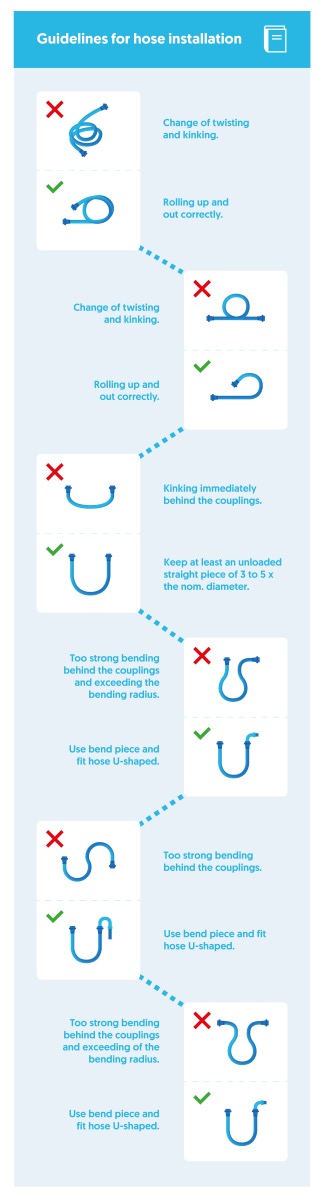
Equipment is more reliable and easier to maintain when hose is installed to the rules below. Most of what looks like a hose failure started as an installation decision.
1. Respect the minimum bend radius
Make the assembly long enough, and route it so the minimum bend radius is never exceeded. Kinking just behind a coupling is the classic failure: keep at least an unloaded straight section of three to five times the nominal diameter at each end.
2. Allow for contraction and expansion
Hose can elongate by up to 2 percent when pressurised, but it can contract by as much as 4 percent. That difference strains the reinforcement wires and eventually fails the hose at the coupling interface. Cut slightly longer than the measured length to absorb it.
3. Avoid multi-plane bending
A hose bent in one plane while an oscillating motion bends it in a second plane twists, and that is what pulls the coupling apart over time. Re-route to remove one of the planes. Where multi-plane bending cannot be avoided, fit a clamp between the bends and leave enough hose on both sides of the clamp to relax the torsion.
4. Keep the hose off abrasive surfaces
A ferrule or clamp holding the hose away from what it would otherwise rub against is cheaper than a cover failure. Where rubbing cannot be routed away, tell us at the quotation stage: a different cover compound is often the better answer.
5. Check the geometry through the full travel
A routing that looks right with the cylinder at rest can bend the hose below its radius at the other end of the stroke. Check both extremes, increase length and clearance if the bend tightens.
6. Store and fit without twisting
Roll hose out, do not uncoil it with a twist. A twist put in at installation stays in the hose and shortens its life. Swivel joints reduce the bending caused by relative movement between machine parts and make replacement simpler.
If a hose keeps failing in the same place, send us the route, the pressure and a photo of the failure. The pattern usually points at one of the six rules above.